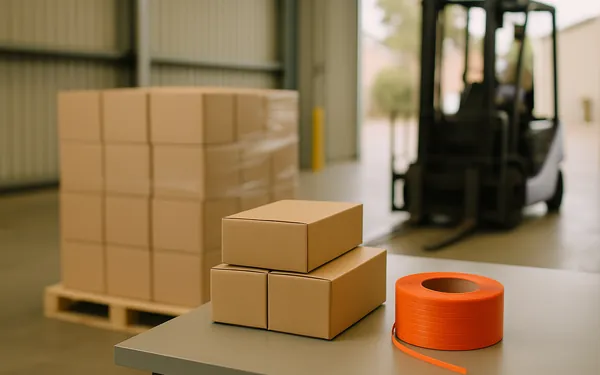
A wholesaler's dock rarely ships one kind of freight. The same afternoon can send a single carton of top-up stock to a café, six cartons to a hardware store, and two full pallets to a distributor's warehouse. Each of those wants a different kind of carrier service, and many wholesalers end up running them through different systems: a parcel account for the cartons, a freight company for the pallets, and a person who knows which is which.
This guide covers how to decide pallet or parcel for each consignment, what goes wrong when the two run separately, and what changes when both sit on one platform.
Why Wholesale Freight Is Mixed
Retail orders tend to look alike. Wholesale orders do not. A trade customer who orders weekly might take a pallet at the start of the month and a few cartons each week after that as stock runs down. A new customer's opening order might be three pallets, and their second order a single box.
That means the decision between pallet and parcel is made per consignment, many times a day, usually by whoever is on the dock. When the decision lives in someone's head, the business depends on that person being at work.
The Decision Points
Five facts about a consignment settle most pallet-or-parcel decisions.
Carton count. A handful of cartons usually travels as parcel freight. Once the cartons would fill a pallet base, stacking and wrapping them onto a pallet often protects them better and makes handling at the other end easier.
Dimensions. Parcel services have size limits per item. A long or awkward item can fall outside them even when it is light.
Weight. Parcel services also have weight limits per item. Heavy items that a person cannot lift safely belong on a pallet with a forklift at each end.
Receiver type. A warehouse with a dock and a forklift can take a pallet. A small shopfront in a strip of shops may have nowhere to put one and no way to unload it. Check what the receiving site can handle before you book, and put it in the delivery instructions.
Delivery window. Some receivers only accept deliveries at set times. Pallet freight to a busy distribution centre may need a booked slot. Note it on the consignment so the carrier plans for it.
What Goes Wrong When They Run Separately
When cartons go through one system and pallets through another, three problems show up.
The record splits. A customer calls about their order, and the answer depends on whether it went as parcel or pallet, so staff check two places.
Nobody compares across the line. An order sitting on the boundary, say eight cartons, gets booked however that system usually books it. Nobody looks at whether it would travel better the other way.
Month-end doubles. Parcel and pallet freight arrive on separate invoices from separate suppliers, and finance joins them by hand.
Your Duties When You Send Pallet Freight
Sending pallets by road puts obligations on the sender as well as the carrier. The National Heavy Vehicle Regulator's Chain of Responsibility page puts it this way: "Everyone who works with heavy vehicles - from the business that employs a driver or owns a vehicle, to the business that sends or receives goods, is accountable for the safety of the heavy vehicle, its driver, and its load".
For a wholesaler, that means the details on the booking matter beyond getting the freight priced. Declare weights and dimensions accurately, pack and wrap pallets so the load stays stable, and read the NHVR's guidance on what the duty means for your business.
Worked Example: One Customer's Month
Take a hypothetical wholesaler of packaged foods supplying a regional grocery group with a central warehouse and several stores.
At the start of the month the group orders a full replenishment for its central warehouse: two pallets, wrapped and labelled, going to a site with a dock and a forklift. During the month, individual stores order top-ups directly: two cartons here, four cartons there, delivered to shopfronts with a rear door and no forklift.
Run separately, the pallets are booked with a freight company by email and the cartons through a parcel carrier's portal. When the grocery group's buyer asks for everything sent to them this month, someone pulls records from both places and builds a list.
Run on one platform, the despatch team books both through the same form. The pallets and the cartons get different carriers and services, because they need them, but every consignment lands in the same list with its service, despatch date, ETA and status. The buyer's question takes one search. The store that received four cartons and the warehouse that received two pallets are both in one history.
Checklist for Putting Both on One Platform
- List the kinds of freight you send: cartons, pallets, long or awkward items, anything over parcel limits.
- Write down your pallet-or-parcel rule for the boundary cases, so the decision no longer depends on one person.
- Record each regular receiver's facilities: dock, forklift, booking requirement, delivery hours.
- Check that the platform covers both parcel and pallet services for your lanes. Senditt covers parcel to pallet, express to standard, metro to regional, across 35+ carriers.
- Decide who holds the carrier accounts. On Senditt the accounts, billing and support are managed for you, and every carrier is booked on Senditt's negotiated rates.
- Plan the switch. You can book the same day: carrier rates are already loaded, so a new account can book and send on day one.
If your dock sends both cartons and pallets and they live in two systems today, book a freight review. There is no lock-in on standard accounts. Fixed terms apply only where you agree to one. The carriers page shows how Senditt runs parcel and pallet carriers through one login.
Senditt is a managed freight platform (4PL). Senditt is not Sendle and is not affiliated with it.